
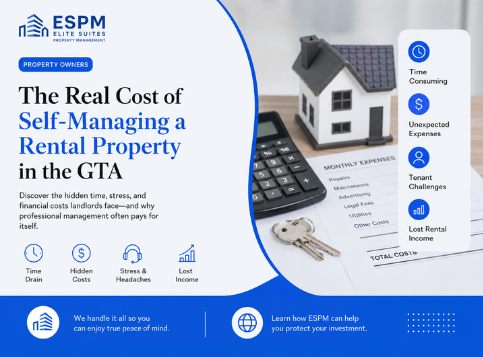
Ask most landlords what property management costs, and they’ll tell you the monthly fee. Ask them what self-managing costs, and most won’t have an answer — because the cost isn’t a line item. It’s scattered across missed calls, extended vacancies, and Saturday afternoons spent showing a unit instead of doing literally anything else.
That gap in how the two options get evaluated is worth closing, especially now. The Canada Mortgage and Housing Corporation’s 2025 Rental Market Report showed vacancy rates for purpose-built rentals hitting a ten-year high across major Canadian cities, with Toronto’s apartment vacancy rate breaking 3% for the first time since before the pandemic. A tighter market for landlords means the cost of doing it yourself has quietly gone up, even if nothing about your own approach has changed.
Vacancy Is the Biggest Hidden Cost, and It’s Rarely Counted Properly
If your unit rents for $2,200 a month, every week it sits empty costs roughly $550 — not in some abstract sense, but as real money leaving your account while the mortgage, taxes, and utilities keep coming due. A vacancy that stretches from one week to three doesn’t feel like a $1,100 problem when you’re living through it, but that’s exactly what it is.
Self-managing landlords tend to underestimate this because the cost is invisible on paper. There’s no invoice for “three extra weeks of vacancy.” It just shows up as a slightly worse year, attributed to a slow market rather than to how the listing was marketed, priced, or shown.
Your Time Has a Rate, Even If You Don’t Bill Yourself For It
The average self-managing landlord spends meaningful hours per month on their rental — fielding maintenance calls, chasing a late payment, coordinating a showing around someone else’s schedule, or replying to tenant messages after work. None of that shows up on a spreadsheet, but it’s not free. It’s time pulled from a job, a family, or actual rest.
The honest way to evaluate property management isn’t “does the fee cost less than doing it myself.” It’s “what’s an hour of my own time actually worth, and how many of those hours does this get back.”
Where the Math Tends to Favor Bringing in Help
A few situations make the cost comparison lean clearly toward hiring a property manager:
- You own more than one unit. The time cost multiplies with every additional property, while a management fee typically scales more predictably.
- You’re not local to the property. Distance turns every small issue into a bigger time cost — you can’t just swing by.
- Your last vacancy ran long. If a unit sat empty for a month in a market where three weeks used to be normal, that’s the market’s new baseline showing up in your numbers.
- You’ve had at least one tenant screening regret. The cost of a bad tenant — missed rent, property damage, eviction proceedings — dwarfs a management fee many times over.
What Full-Service Management Actually Buys You
At ESPM Resource Centre, full-service property management covers the parts of ownership that create the most hidden cost: professional photography and marketing that shortens vacancy, tenant screening that catches problems before they move in, rent collection and follow-up, move-in and move-out inspections, maintenance coordination, and monthly reporting that tells you exactly where the property stands without you having to ask.
None of that replaces owning the property. It replaces the version of ownership that quietly costs more than it looks like on paper.
For the more formal side of tenancy matters — notices, late rent procedures, and dispute resolution — Ontario’s Landlord and Tenant Board remains the authoritative source regardless of who’s managing the property day to day.
Self-managing isn’t wrong. It’s just worth pricing honestly, especially in a market that doesn’t behave the way it did three years ago.